UMD Media , February 5, 2026

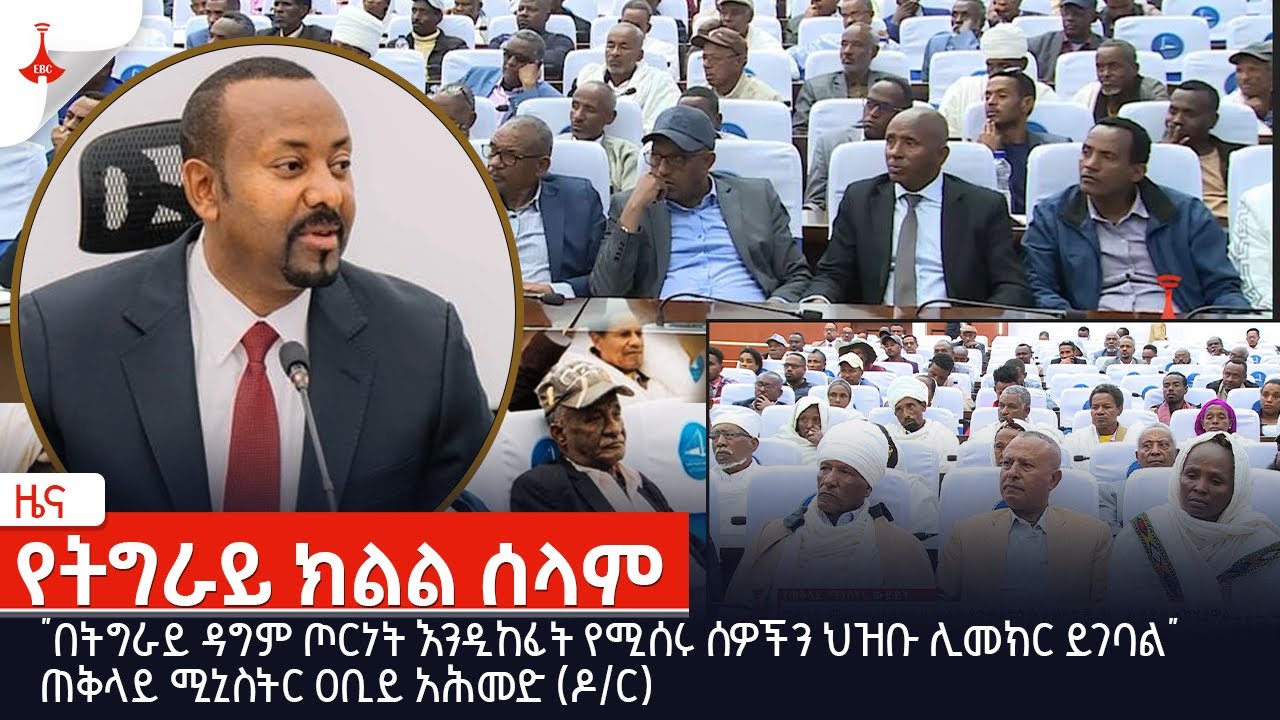
Prime Minister Abiy Ahmed, in a parliamentary address on February 2, 2026, publicly described tensions with Eritrea during the Tigray war, citing alleged destruction and abuses committed by Eritrean forces in several towns across Tigray.
In his remarks, Abiy stated:
“We did not fall out with the Eritrean government because we raised the issue of the Port of Assab. The conflict began when, as we entered Shire, Eritrean forces were demolishing buildings; when we passed through Axum and the youth of Axum were being massacred; when factories in Adwa were dismantled and looted; and when in Adigrat they uprooted the pharmaceutical factory and destroyed what they could not remove.”
The Prime Minister added that his government was aware of these developments at the time but chose not to speak publicly while fighting “on multiple fronts.” He further claimed that he had sent envoys to Asmara to urge Eritrean authorities to stop “mistreating my people,” referring to the people of Tigray.
During the address, Abiy referenced former Foreign Minister and security adviser Gedu Andargachew as a witness to these communications, stating that Gedu, currently in exile in the United States, would confirm the account. He noted Gedu’s personal integrity, describing him as a devout Orthodox Christian.
Gedu Responds
On February 4, 2026, Gedu Andargachew issued a three-page written response in Amharic disputing the Prime Minister’s account. The statement, translated by UMD Media (see below in full), challenges several elements of Abiy’s parliamentary remarks.
In his letter, Gedu asserts that Abiy’s claim that he was serving as Foreign Minister during the relevant period is “entirely false,” stating that he was removed from the position on November 4, 2020, the day after the war began.
He further maintains that while he did travel to Asmara as an envoy in early January 2021, the message he carried differed significantly from the one described in Parliament. According to Gedu, the message conveyed three main points:
1. A congratulatory message to President Isaias Afwerki regarding joint military operations against the TPLF.
2. Expressions of gratitude for Eritrea’s support.
3. A discussion about managing international scrutiny over alleged human rights violations.
Gedu states that he suggested explicitly requesting Eritrean troop withdrawal from Tigray but was “strictly warned” not to raise that issue. He writes that no message regarding the mistreatment of the people of Tigray was included in the instructions he received.
In his statement, Gedu also criticizes the Prime Minister’s broader handling of the war, arguing that responsibility for the destruction in Tigray cannot be attributed solely to external actors. He further alleges that Abiy previously expressed hardline views toward the people of Tigray during internal meetings.
Broader Implications
The exchange marks a rare and direct public contradiction between the Prime Minister and a former close ally who served in senior positions during the war. Gedu’s letter add new details to ongoing debates about decision-making, Eritrea’s role in the conflict, and accountability for wartime actions.
Abiy Ahmed’s statements in Parliament about Eritrea’s role in the Tigray war this week contradict his own earlier pronouncements in Parliament and in the media.
FULL TRANSLATION
Date 04/02/2026
Translated by UMD Media
To Honorable Prime Minister Abiy Ahmed
From Gedu Andargachew
Subject: Concerns the speech you made in Parliament mentioning my name.
I have understood from a clipped video of your speech delivered in Parliament on February 2, 2026 sent to me by people that you cited me as a reference while explaining the cause of the disagreement that arose with Eritrea. Your speech has compelled me to clarify the situation without any addition or subtraction, so that the matter may be recorded in history correctly. Based on this:
1. On my part, I had no desire to give an opinion on matters concerning the relations between Eritrea and Ethiopia. This is because I believe that the history of relations between these two sisterly countries, being largely filled with conflict, should be handled with caution and responsibility. Therefore, I had decided not to speak about the matter as I know it. In any case, since the Tigray war began until the Pretoria agreement halted it, I don’t think there was a time when the Eritrean military remained without crossing sides from the Ethiopian National Defense Force. Furthermore, we recall that in 2021., during the summer, when Tigrayan forces crossed into the Amhara region, the Eritrean military came as far as the Debre Tabor area (in Debub Gondar Zone of the Amhara Region in northern Ethiopia, situated approximately 100 km southeast of Gondar) and fought. The Ethiopian National Defense Force and the Eritrean military stopped conducting joint military operations only after the public announcement of the cessation of hostilities agreement reached through the Pretoria talks. Until then, however, they were together in a manner resembling one country’s army. If there was any difference, it might be that after the second round of war ended in the middle of the conflict and Tigrayan forces left the Amhara region, when the war paused, while Ethiopian Defense Force officers were being promoted in rank, Eritrean officers were not included.
2. After all that damage, at this time, while I was expecting you to ask for forgiveness from both the people of Tigray and the people of Ethiopia, you presented the issue in a convoluted manner, and I chose to give an explanation only on the minor point you raised. The damage inflicted through the participants of the war, including the Tigrayan forces, during the war in the Tigray region has placed the people of Tigray in an unbearably difficult situation. Therefore, trying to absolve oneself by claiming “I am innocent of the blood” while holding only one party accountable for this act, beyond being unable to escape legal, political, and moral accountability, will prevent the appropriate lesson from being learned so that such destruction is not repeated. To tell the truth, during that war, the people of Tigray had no government or other side that stood by them, saying that their kin were being harmed.
It can be said that only a few Ethiopian political figures, international organizations, and certain foreign governments were able to withstand the government pressure and stand by the people of Tigray to a certain extent. This is our, the Ethiopians’, true and tragic recent history.
3. I could have been one of those people who would be happy if God guided you to improve your terrible and broken relationship with the people of Tigray. However, beyond showing no sign of remorse for your past mistakes, you are searching for another scapegoat without considering your own share of responsibility for all that mass killing, destruction of property, social upheaval, and the crisis threatening the nation’s existence. Moreover, the current turmoil seems like an effort to create another new crisis that overshadows the existing critical national situation, which has caused me great concern. The reason is, as I stated above, the root cause of the national damages inflicted on the people so far is your rule, yet you always try to present external fabricated reasons. The Tigray war, the widespread destruction being inflicted on the Amhara people, the endless war in the Oromia region, the conflict in Benishangul and the recent one in Gambella, including the national crises that have caused much damage in other areas of the country, are primarily problems born from your erroneous belief that you cannot stay in power without conflict and war, stemming from the weakness of your rule.
4. Given the overall situation described above, I feel compelled to move on to clarifying the raw facts regarding my travel to Eritrea as your envoy, as you outlined in your speech. First and foremost, the statement you made in your parliamentary address that I was the Foreign Minister after the Tigray war started and that I was sent to Eritrea as your envoy regarding the crime committed against the people of Tigray is entirely false. This is a clear fabrication, and unless you are suffering from a lapse of memory or unless you intend to use it to stir up the people for a new destructive project you plan to execute, this fact is clear to anyone who follows Ethiopian politics. I was removed from the Foreign Ministry the day after the Tigray war started, meaning from November 4, 2020 onwards. It is unthinkable that you would forget this matter. Unless there is some other destructive agenda you are plotting to execute against the people and the country that you want to use this to foment, my tenure as Foreign Minister and my travel to Eritrea are unrelated matters.
5) Regarding the immense damage inflicted on the people in connection with the Tigray war, ( in your parliament speech this week) you have urged me to testify to confirm that you sent me to Eritrea carrying a message saying “Do not mistreat my people.” Honorable Prime Minister, you have also made a great mistake here. The truth I know is different, so I cannot be a good witness for you in this regard. You would be better off finding another witness who aligns with your version, which is detached from the truth. If you want me to speak about your view of the people of Tigray, the truth I know is vastly different from what you said. In fact, to tell the truth, one of, and perhaps the main, issues that angered you at that time and caused you to see others as enemies was the raising of the issue of the mistreatment of the people of Tigray. Let me remind you of my own experience. At the executive committee meeting called to celebrate the claim that “we have shattered the TPLF’s power in three weeks and taken control of Mekelle,” based on the assessment presented, I raised a point. The assessment that was presented stated that the people of Tigray viewed the attack on the Northern Command and the defensive measure taken as a sudden affair, hence stood aloof from any side, observing the war neutrally. I, aligning with this assessment, suggested that caution must be taken so that the people are calmed, lawlessness is not created, the military does not harass the people with a spirit of victory and vengeance, a civilian administration should be quickly established and run by its own children, and if injustice is inflicted, there is a risk that they might long for the TPLF and restrengthen the TPLF. I presented a detailed opinion containing this concern. You, from the podium, listened to the idea I raised with a positive attitude and passed over it. After the meeting was over and as we were leaving the meeting hall, I remind you of what you called me aside and told me, which accurately shows your view of the people of Tigray. This is what you told me: “Don’t think that Tigrayans, from now on, can recover from the defeat that befell them and rise up strong. We have crushed them so they won’t rise. Many people say ‘the people of Tigray, the people of Tigray.’ How are the people of Tigray better than anyone? We have crushed them so they won’t rise. We will crush them even more in the future. Since defeat is heavy, from now on, the Tigray we knew will not return.” Also, after Tigrayan forces left the Amhara region and returned to Tigray, when pressure was mounting from the international community to negotiate, the negotiation strategy you stated at a public meeting you would follow was one that would dismantle Tigray slowly. This is the truth. This is what I know and your true attitude towards the people of Tigray.
6) The only partially true aspect of your parliamentary speech is my travel to Eritrea. Although I cannot remember the exact date, around the beginning of Tir 2013 E.C (January 2021), I took a Ministry of Foreign Affairs official and went to Asmara to deliver your message to President Isaias Afwerki, and he returned the next day. The content of the message focused on the following three issues:
1st) To convey a congratulatory message to President Isaias for our joint victory in the coordinated operation we undertook against the TPLF,
2nd) To express gratitude to the Government and People of Eritrea for their brotherly support in receiving our forces and providing them with care when the Northern Command which is part of the Ethiopian Defence Army was attacked, and subsequently in preparing for a counter-offensive.
3rd) That some supporters of the TPLF and external forces who do not desire the good relations between Ethiopia and Eritrea have initiated a widespread defamation campaign through various international organizations and media outlets, linked to allegations of human rights violations. The messages conveyed were that since this matter, if left unchecked, could bring trouble upon both of us, we must exercise shared caution.
After you relayed these messages intended for the President, I, for my part, raised a question to you about adding one more point to include. That was, we have publicly announced the end of the war. What the international community is asking of us is for the Eritrean forces to withdraw from Ethiopia/from Tigray. So, why don’t we explicitly tell the Eritrean government to withdraw its forces? But you strictly warned me not to ask them to withdraw their forces. Then, I accepted the mission given to me and we parted. Beyond this, there was no message you gave me or even mentioned to me concerning the people of Tigray. At that time, the concern that preoccupied you was the trouble that the opened human rights violation case could bring upon us, not at all the suffering that befell the people of Tigray.
The next day, we boarded a small charter plane prepared for us and arrived in Asmara. Eritrean officials were present at Asmara Airport and after receiving us, they took us to where President Isaias was. We presented the message we held for the President. There was nothing in the message we carried that created controversy between us and them. What I recall is that when I explained to President Isaias about the human rights violation campaign against us, the response from his side was, “All necessary caution should be taken. We will pass on instructions to our subordinate structures, and you do the same. For the rest, there is much work to be done as Abiy and I have agreed.” Although I have no knowledge of the alleged agreement between the two leaders, we concluded our discussion in complete agreement and returned to our country.
Upon my return to Addis Ababa, I called you the next day and reported to you that in my positive conversation with President Isaias, he said regarding the human rights issue that we all must exercise the necessary caution. Our phone conversation then ended. This is the truth I know.
Thank you.
Gedu Andargachew